
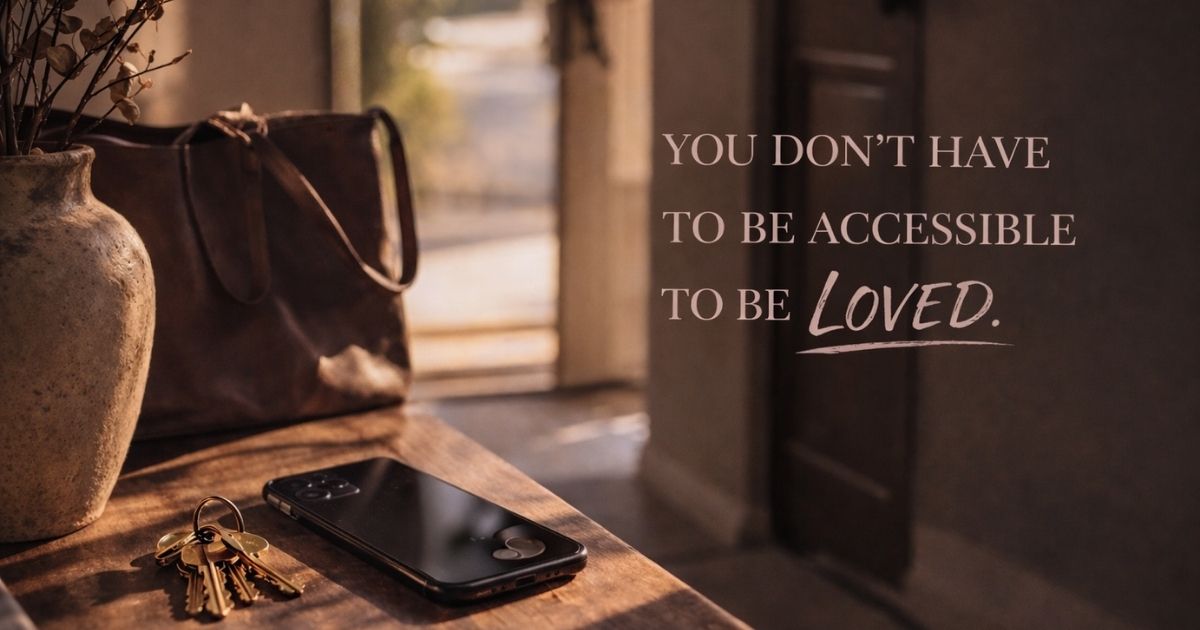
You Don’t Have to Be Accessible to Be Loved
There is an unspoken expectation that you should always be reachable. Not just physically, but emotionally and mentally.
That you should respond quickly. That you should be available when someone needs you. That your time can be adjusted, rearranged, or extended without much thought. It doesn’t always come across as a demand. Most of the time, it shows up as habit.
⸻
You answer because you saw the message.
You pick up because your phone rang.
You pause what you’re doing because someone else needs something in that moment.
You tell yourself it’s not a big deal and sometimes it isn’t. But over time, it becomes a pattern where your attention is always partially elsewhere.
⸻
For a lot of Black women, accessibility becomes tied to identity.
Being dependable. Being supportive. Being the person people can count on without hesitation. It’s not just about helping. It becomes part of how you show care, how you maintain relationships, how you prove that you’re present. The problem is not that you care. The problem is that constant accessibility leaves no room for you to exist without interruption. There is always something waiting.
A message.
A call.
A request.
A conversation that needs your energy.
Even when nothing is happening, there’s a quiet anticipation that something will.
⸻
That kind of constant openness creates a subtle pressure. You start checking your phone more often. You feel the need to respond even when you don’t have the capacity. You interrupt your own thoughts, your own rest, your own time just to keep up with what’s coming in. It doesn’t feel like pressure at first. It feels like responsibility. It feels like being a good friend, a good partner, a good mother, a good daughter.
It feels like doing what you’re supposed to do. But over time, it becomes exhausting, because you’re doing too much in a visible way. But because your attention is never fully your own.
⸻
Living softer requires changing that dynamic. Not by cutting people off or becoming distant. But by recognizing that your availability is something you get to decide. You don’t have to respond immediately just because you saw something. You don’t have to answer every call. You don’t have to engage in every conversation the moment it’s presented to you. You don’t have to explain why you need time to yourself.
You can take a moment before responding.
You can come back to something later.
You can choose not to engage at all if you don’t have the capacity.
None of that makes you inconsiderate. It makes you aware of your limits. One of the hardest parts about shifting this is that people are used to a certain version of you. They are used to immediate responses. They are used to access. They are used to you adjusting.
When that changes, it can feel uncomfortable. There may be confusion. There may be pushback. There may be moments where you question if you’re doing too much or not enough. You’re not. You’re just changing the way you relate to your time.
⸻
Being less accessible does not mean you care less. It means your care is no longer automatic. It’s intentional. It’s given from a place where you are also considered. You can still be present in your relationships. You can still support the people you care about. You can still show up. But it doesn’t have to come at the cost of constantly interrupting yourself.
Your time is not something that needs to be continuously open. It’s something you get to protect, organize, and decide how it’s used. And when you start doing that, something shifts. Your days feel less fragmented; your thoughts have more space; your energy isn’t being pulled in multiple directions at once.
⸻
You start to feel more grounded in your own life instead of reacting to everything happening around you. You don’t have to be accessible to be loved. You don’t have to be constantly available to be valued. You don’t have to respond immediately to maintain connection.
The people who are meant to be in your life will adjust to your boundaries. And, more importantly, you will finally have space to be present with yourself.
Where in your life are you still operating like you have to be available all the time?